Top 5 Chinese Electric SUVs for the Middle East Market in 2025
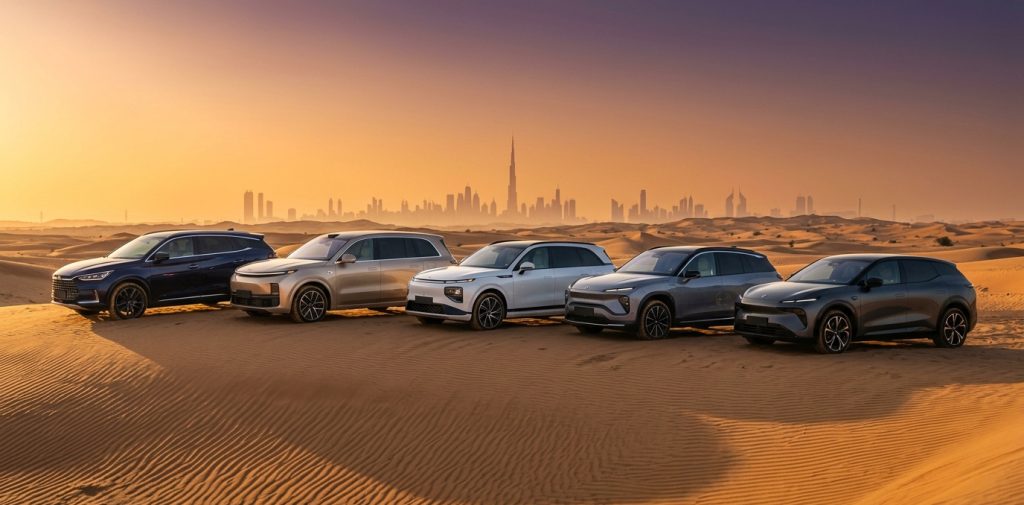
The Middle East is witnessing an automotive revolution. Walk through any parking lot in Dubai, Riyadh, or Doha, and you will see them everywhere: sleek, silent, and surprisingly powerful Chinese EV SUVs.
For decades, Gulf drivers relied on petrol-guzzling SUVs. Not anymore. Soaring fuel prices, aggressive government net-zero targets, and a rapidly expanding charging network have opened the door. And Chinese automakers have charged right through it.
What makes them so appealing? They offer something Western luxury brands struggle to match: affordable luxury, cutting-edge battery technology, and vehicles engineered specifically for desert climates.
Here are the top five Chinese SUVs dominating Middle Eastern roads in 2025.
The Selection Criteria: Battery Cooling Systems and AC Performance
Let us be honest. Most electric vehicles hate extreme heat. When summer temperatures hit 50°C in the shade (and 70°C on the pavement), ordinary EVs lose range, charge slowly, or simply shut down.
The best EVs for desert climate must solve three critical problems.
First, battery cooling. Look for liquid-cooled battery packs or LFP Blade Batteries. These systems maintain safe operating temperatures even during fast charging in brutal summer heat.
Second, AC performance. A weak air conditioner is a dealbreaker in the Middle East. The top contenders cool the cabin from 50°C to 22°C in under 10 minutes without draining the battery.
Third, dust and sand resistance. Sand gets everywhere. Quality Chinese EV SUVs seal their battery compartments, motors, and electronic components against fine desert particles.
Every SUV on this list passes these tests. Many have survived the infamous “China Summer Test” in Turpan — one of the hottest inhabited places on Earth.
Detailed Breakdown of the Top 5 Chinese EV SUVs
1. BYD Tang / Song Series (Reliability and Blade Battery)
If you want the most dependable Chinese EV SUVs for family use, start with BYD. The BYD Tang (7-seater) and BYD Song L (5-seater crossover) are the workhorses of the GCC electric fleet.
What makes them special? The Blade Battery. Unlike nickel-based batteries that overheat and degrade, BYD’s LFP (Lithium Iron Phosphate) chemistry remains remarkably stable at high temperatures. It passes the nail penetration test without catching fire — a critical safety feature.
In real-world desert driving, owners report less than 10% range loss at 45°C. The Tang offers AWD, over 500 km of range, and a spacious, family-friendly interior. The Song L is smaller, lighter, and more affordable.
Both come with GCC-spec software that runs the cooling fans longer after parking to “heat soak” the battery. Smart engineering for a smart region.
Best for: Families who want zero drama, low maintenance, and proven reliability.
2. Li Auto L9 (The EREV Advantage for Long Distances)
Range anxiety is real when you drive from Dubai to Liwa or across Saudi Arabia’s vast Empty Quarter. The Li Auto L9 kills that anxiety completely.
The L9 uses EREV (Extended Range Electric Vehicle) technology. You get a 65 kWh battery for about 220 km of pure electric driving. When the battery runs low, a silent 1.5T petrol generator kicks in to recharge it. Total range exceeds 1,400 km. No charging stations needed. No range stress.
But the L9 is not just clever — it is luxurious. The 6-seater cabin includes:
A built-in refrigerator (perfect for keeping water cold at 50°C)
Rear massage seats with heating and ventilation
A 15.7-inch OLED entertainment screen for passengers
A 21-speaker sound system
The AC performance is brutal in the best way. The L9 cools the cabin faster than any other vehicle on this list. For large families who take long road trips, the Li Auto L9 is unbeatable.
Best for: Long-distance travelers and large families who want petrol backup without sacrificing electric driving.
3. XPeng G9 (Fastest Charging in the Desert)
Many buyers overlook XPeng. That is a mistake. The XPeng G9 holds a real advantage for Middle Eastern drivers: the fastest mass-production charging on the market.
The G9 uses an 800V silicon carbide platform. At a 480kW charger (available now at select ADNOC stations in the UAE), the G9 adds 200 km of range in just 4 minutes. From 10% to 80% battery takes only 15 minutes.
Here is the desert secret: the G9 actively pre-conditions the battery before you arrive at a charger. In summer heat, this means you get full charging speed every time, no thermal throttling.
The interior features a dual 14.96-inch display for driver and passenger. The ride is whisper-quiet and smooth thanks to dual-chamber air suspension. Range reaches 570 km WLTP.
Best for: Tech buyers and road-trippers who want the absolute fastest charging speeds.
4. NIO EL6 (Battery Swapping for Zero Downtime)
The NIO EL6 offers something no other brand on this list provides: battery swapping.
NIO has built battery swap stations in the UAE (Dubai and Abu Dhabi) and Saudi Arabia (Riyadh and Jeddah). Drive in. Three minutes later, drive out with a 90% or 100% charged battery. No waiting at a charger. No worrying about battery degradation in the desert heat. The EL6 uses swappable 75 kWh or 100 kWh packs.
The EL6 itself is a mid-size luxury SUV with dual-motor AWD and over 480 horsepower. Zero to 100 km/h takes 4.5 seconds. Range hits approximately 500 km WLTP.
The interior features NIO’s signature “second living room” design with premium leather, ambient lighting, and a robotic NOMI assistant that responds to voice commands.
Best for: City dwellers living near swap stations who hate waiting at public chargers.
5. Zeekr 7X (Modern Family Luxury SUV)
You may have heard of the Zeekr 001 — a stunning luxury shooting brake that has won design awards worldwide. But the 001 is not an SUV. For SUV buyers, Zeekr offers the Zeekr 7X.
The 7X is a proper five-seat luxury electric SUV designed specifically for families. It shares Zeekr’s 800V architecture, meaning ultra-fast charging: add over 300 km of range in 15 minutes at a fast charger.
The 7X features:
Up to 600+ km WLTP range (long-range variant)
Dual-motor AWD with rapid acceleration (0-100 km/h ~3.8 seconds)
Smart air suspension for a smooth ride over rough desert roads
An electrochromic panoramic glass roof that tints electronically to block UV rays
Premium cabin with recycled microfiber and YAMAHA audio
Zeekr has established official showrooms in the UAE and Saudi Arabia, offering full GCC-spec modifications and warranties. For buyers who want the sporty, premium feel of Zeekr in a practical SUV package, the 7X is the answer.
Best for: Families who want Porsche-level design and performance in a practical SUV.
BYD vs Zeekr Export: A Direct Comparison
Since BYD vs Zeekr export is a popular search, here is a direct comparison between BYD’s flagship SUV (Tang) and Zeekr’s flagship SUV (7X).
| Feature | BYD Tang | Zeekr 7X |
|---|---|---|
| Vehicle Type | 7-seat mid-size SUV | 5-seat luxury SUV |
| Price (UAE estimate) | ~AED 210,000 | ~AED 230,000 |
| Horsepower | 517 hp | 480+ hp (AWD) |
| 0-100 km/h | 4.6 seconds | ~3.8 seconds |
| Range (WLTP) | ~530 km | ~600 km+ |
| Battery Type | Blade LFP (safe, stable) | 800V NMC (fast charging) |
| Charging Speed | 110 kW max | Up to 360 kW |
| Best For | Large families, safety focus | Speed, design, fast charging |
Verdict: Buy the BYD Tang for 7-seat capacity, proven Blade Battery safety, and lower running costs. Buy the Zeekr 7X for breathtaking design, ultra-fast charging, and sporty performance.
Charging Infrastructure Compatibility (CCS2 vs GB/T)
Here is critical advice that many online guides get dangerously wrong.
The Middle East uses CCS2 (Combined Charging System Type 2) as the public charging standard. DEWA in Dubai, ADNOC across the UAE, Saudi’s EVC, and Qatar’s Kahramaa all use CCS2 plugs. Type 2 AC is used for home charging.
Chinese domestic-market EVs use GB/T. However, every official GCC-spec Chinese EV SUV on this list ships with a native CCS2 port. Do not accept a GB/T vehicle.
If you buy a grey-market import with GB/T, you will face three problems:
Adapters exist but are bulky and expensive.
Adapters can overheat and fail in 50°C weather.
Charging speed is often reduced.
Always ask the dealer directly: “Does this car have a native CCS2 port or Type 2 AC port?” If the answer is GB/T only, walk away.
GCC-Spec Modified Vehicles
You cannot buy a standard Chinese EV from a cold climate and expect it to survive a Gulf summer. You need a GCC-spec modified vehicle.
What GCC modifications include:
Aggressive battery cooling mapping (fans run longer and faster)
Higher capacity AC compressors rated for 50°C+
Sand and dust sealing for battery and motor compartments
Nitrogen-filled tires to prevent pressure spikes in extreme heat
Arabic language support and local navigation maps
Adjusted suspension tuning for desert roads
Chinese EV SUVs have arrived in the Middle East — and they are here to stay. They are reliable, luxurious, fast-charging, and specifically engineered for desert heat.
Whether you choose BYD for rugged family safety, Li Auto for endless EREV range, XPeng for record-breaking charging speeds, NIO for battery swapping convenience, or Zeekr for breathtaking luxury design, you cannot go wrong.
The only mistake is waiting too long.
Contact us to inquiry one of these five amazing SUVs, and experience the future of desert driving for yourself.
Keywords: Chinese EV SUVs, best EVs for desert climate, BYD vs Zeekr export, BYD Tang Middle East, Li Auto L9 range extender, XPeng G9 fast charging, NIO EL6 battery swap, Zeekr 7X luxury SUV, CCS2 charging GCC, GCC spec EV modifications, electric SUV Dubai 2025, desert climate electric vehicles, Chinese electric cars 2025