Electric Delivery Vans: Slashing Operational Costs for Logistics Companies
Let’s be honest. If you run a logistics fleet, you don’t care about “saving the planet” as much as you care about saving your margin. Diesel prices are unpredictable. Maintenance bills keep climbing. And every new low-emission zone feels like a toll booth aimed directly at your bottom line.
But here’s the good news. Electric delivery vans have stopped being a compromise and started being a competitive weapon. The “Green Logistics” trend isn’t just about compliance anymore—it’s about cutting real costs on the last mile. The most expensive part of your supply chain is now the easiest place to save money.
Let’s break down why fleet managers are switching to electric logistics vans, how the new wave of Chinese vans (Maxus and Farizon) actually perform in the real world, and why your depot needs chargers more than it needs another diesel pump.
Payload and Range: Comparing Chinese E-Vans (Maxus, Farizon)
The old excuse was simple: “Electric vans can’t carry enough, and they won’t make the route.” That excuse died about two years ago.
Take the Maxus eDeliver export series. The eDeliver 5 hauls up to 1,250 kg of payload with a cargo volume of 7.6 m³. That’s not “light duty”—that’s a full workday for any urban logistics crew. Range? WLTP numbers land between 339–489 km depending on the battery pack. In real-world city stop-start traffic, you’ll see the higher end because regenerative braking works harder.
The eDeliver 3 is the nimble sibling. 865–1,202 kg payload, smaller footprint, perfect for narrow city streets and tight loading docks. Both support DC fast charging—80% in under an hour. For a logistics manager, that means a driver can take a lunch break and add 150 km of range. No drama.
Now look at Farizon. These vans are built for volume. Payload hits 1,300–1,390 kg, and cargo space stretches to 13 m³ in the long-wheelbase version. Range on the 83 kWh battery is 319–376 km WLTP. Fast charging from 30% to 80% in 36 minutes. And here’s the kicker—they can tow. That matters if your logistics company does mixed duty (delivery plus occasional pickup).
Which one wins?
Maxus: Better cabin comfort, proven export reliability, smoother ride.
Farizon: More cargo volume, higher payload ceiling, slightly faster charging.
For pure last-mile delivery EVs, Maxus is the safe bet. For mixed fleets or high-volume parcel work, Farizon pulls ahead. Either way, both outperform diesel in stop-start traffic, where instant torque means faster acceleration between lights. That adds up to more stops per hour.
Total Cost of Ownership (TCO) Analysis: Fuel vs. Electric
This is where the magic happens. Upfront cost is higher. Anyone telling you otherwise is lying. But you don’t buy vans—you buy deliveries per dollar.
Let’s run real numbers for a fleet of 10 electric delivery vans, each doing 25,000 miles per year.
Fuel (Diesel vs. Electric):
Diesel: 30 MPG → 833 gallons → at 4.50/gallon=∗∗4.50/gallon=∗∗3,749 per van/year**
Electric: 0.4 kWh/mile → 10,000 kWh → at 0.14/kWh(depotovernightrate)=∗∗0.14/KWh(depot overnight rate)=∗∗1,400 per van/year**
Annual fuel saving per van: $2,349
For 10 vans: $23,490 saved every year
Maintenance:
Diesel: Oil, filters, belts, exhaust, turbos → ~0.10/mile=0.10/mile=2,500/year
Electric: Tires, cabin filter, windshield fluid → ~0.04/mile=0.04/mile=1,000/year
Annual maintenance saving per van: $1,500
For 10 vans: $15,000 saved every year
Total operational savings per year (fuel + maintenance): $38,490
Over five years, that’s $192,450 in pure savings. And that’s before you add government incentives (HVIP in California, grants in the EU, tax breaks in the UK). With those, your payback period drops to 2–3 years.
Here’s what logistics CFOs love most: predictability. Diesel prices spike when a refinery sneezes. Electricity rates change once or twice a year. That stability alone is worth the switch.
Charging Solutions for Fleet Depots
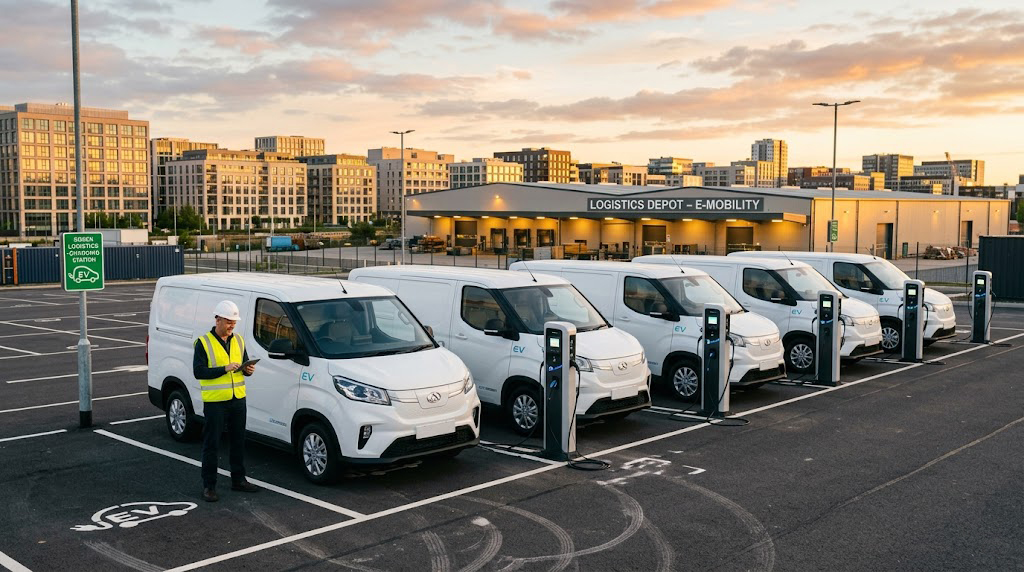
You don’t need a supercharger for every van. That’s a rookie mistake. Most electric delivery vans sit in the depot for 10–12 hours overnight. That’s plenty of time.
The smart depot setup:
Level 2 AC chargers (11–22 kW): Adds 50–70 km of range per hour. In 10 hours? That’s 500–700 km. More than any van needs.
Load management software: Stops all 10 vans from charging at once when you plug them in at 6 PM. Spreads the load, avoids demand charges.
One or two DC fast chargers (50 kW): For the vans doing double shifts or unexpected long runs.
What about drivers who take vans home?
Install 7 kW chargers at their houses. Reimburse the electricity at a flat rate. It’s still 70% cheaper than diesel. And you save depot space.
The hidden win? Time. A diesel driver spends 10–15 minutes at a gas station every morning. Ten drivers = 2.5 hours of lost labor per day. That’s 12.5 hours a week. 650 hours a year. Electric vans plug in while drivers clock out. That’s free productivity.
Future-Proofing Your Logistics Business
The era of cheap diesel is over. City centers are locking out combustion engines. Customer contracts are starting to ask for your carbon score. But the real reason to switch to electric delivery vans is simpler than all of that: They save you money on every single mile.
The Maxus eDeliver export and Farizon vans have proven that payload and range are no longer problems. Depot charging is cheaper and easier than most fleet managers expect. And the TCO math is now undeniable—diesel loses, electric wins.
You don’t have to flip your whole fleet tomorrow. But take one route. One van. One driver. Run the numbers for six months. You’ll find that the only regret is not switching sooner.
Stop burning profits at the pump. Contact us and get your free electric fleet assessment today.
Keywords: electric delivery vans, electric logistics van, Maxus eDeliver export, last-mile delivery EVs, Farizon electric van, electric van TCO, depot charging solutions, green logistics fleet, commercial electric van range, last-mile electrification